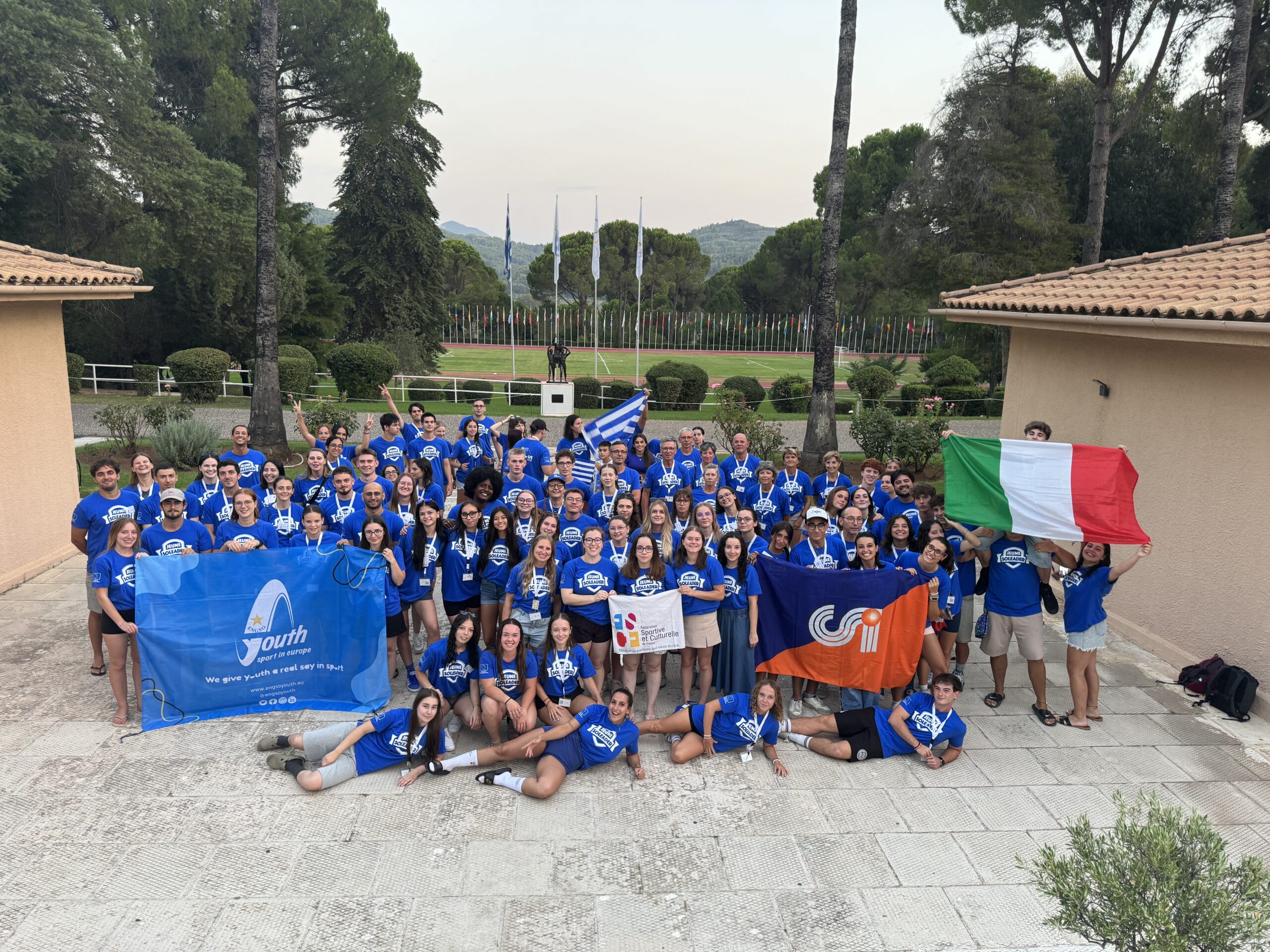
Across one week, it became a space to explore much more than sport itself – from human rights and inclusion to sustainability, youth participation and active citizenship. Through workshops, intercultural sports, participant-led activities, reflection sessions and visits to places connected to the Olympic movement, participants were encouraged not only to learn, but to take an active role in shaping the exchange.
For ENGSO Youth, one of the central questions throughout the exchange was: What does it actually mean for young people to participate?
During a session on youth participation, participants explored Roger Hart’s Ladder of Participation, looking at the difference between simply involving young people and giving them meaningful opportunities to influence decisions. The discussions also connected closely with the experiences of the participants themselves – from sports clubs and schools to youth organisations and local communities.
As one participant reflected:
“The workshops on human rights, youth participation, sport, and inclusion gave us new perspectives on the importance of empowering young people and creating opportunities for them to share their voices.”
Human Rights Education through Sport was another key part of the programme. Rather than approaching human rights only through theory, participants explored the topic through experiential activities from ENGSO Youth’s Human Rights Education through Sport manual, including “The Fair Throw” and “(Un)level the Playing Field.”
The activities created opportunities to discuss equality, discrimination, fairness and inclusion, while connecting the experience on the playing field with situations young people may encounter in sport and beyond.
Participants particularly highlighted the value of seeing how activities can be adapted so that people with different abilities can participate and feel included.
The exchange also explored the role of sport in contributing to the Sustainable Development Goals (SDGs).
The activity demonstrated how sport and non-formal education can create accessible entry points for discussing complex global challenges.
The programme also created opportunities to discover the cultural and sporting heritage of Olympia. Participants visited Ancient Olympia, the Olympic Museum and the International Olympic Academy, connecting the discussions of sport and society with the history and values of the Olympic movement.
For participants, these experiences were an important part of the exchange:
“Visiting the archaeological site was particularly meaningful, as it made me reflect on the immense cultural significance and history surrounding the place.”
At the same time, intercultural sports and informal activities helped bring participants together across different languages, cultures and backgrounds.
“The sports tournaments brought us closer together, even when we did not speak the same language, showing us how sport can connect people beyond cultural and linguistic differences.”
For the ENGSO Youth facilitators, the exchange was also a learning experience.
Good facilitation is not simply about delivering content or having all the answers. It is about creating an environment where people feel comfortable to participate, question, exchange experiences and take ownership of their learning.
One participant described the exchange as a particularly valuable experience because of the balance between learning, reflection and informal time:
“I appreciated this balance, as it gave participants enough time to process what they had learned, reflect on it, and exchange ideas with others.”
SoLeader demonstrated the potential of sport as a space for learning, connection and participation. But the real impact of a youth exchange does not end when participants leave.
The challenge now is to bring the conversations, activities and ideas developed in Olympia back to sports clubs, organisations and local communities.
Young people need more than a seat at the table. They need the space, trust and responsibility to help shape what happens next.
And that is where participation becomes action.